

Thermal energy storage
How does it work?

Renewable Energy Is Transforming How Businesses Use Power
Solar PV has become one of the most effective ways for commercial and industrial sites to cut energy costs and reduce emissions. As more businesses electrify heating, cooling, and process loads, on-site renewables offer a clear pathway to lower operating costs and long-term decarbonisation.
But the energy landscape is changing fast and high renewable penetration brings new challenges that weren’t part of the conversation a few years ago.

The Downside of a High-Renewables Grid
• Negative daytime pricing When solar supply exceeds demand, wholesale prices collapse — sometimes below zero.
• Curtailment and zero-export limits Many sites now face forced export restrictions during the middle of the day.
• Stranded-asset risk Without a way to shift energy to when it’s actually needed, even well-sized PV systems can become under-utilised investments.
Businesses are increasingly exposed to:
The value of your renewable asset is no longer determined by how much it generates, but by how much of that generation you can use.

TES: Your Hedge Against Negative Pricing and Curtailment
Phase Change Material Thermal Energy Storage (PCM/TES) allows businesses to capture low-value or curtailed solar energy during the day and release it later when cooling demand and energy prices peak. Instead of wasting renewable energy, TES converts it into stored thermal capacity that directly offsets compressor load — protecting the value of your solar investment and reducing exposure to volatile pricing.

Traditional thermal storage systems operate on fixed schedules — charge at night, discharge during the day. That approach no longer works in a modern electricity market where prices, solar output, and grid conditions change hour-to-hour.
To capture the full value of renewable energy, TES must operate dynamically, responding in real time to:
Why TES Must Be Dynamic, Not Static
• Price Volatility
• Solar Generation Forecasts
• Cooling Demand
• Export Constraints
• TES State of Charge
Without dynamic control, TES becomes just another static asset. With dynamic control, TES becomes a flexible energy-shifting tool that protects your solar investment and maximises the value of every kilowatt you generate.

ACFA: Dynamic Control That Makes TES Actually Work
• Wholesale Electricity Pricing
• Solar Generation Forecasts
• Cooling Demand Profiles
• Export Constraints
• TES State of Charge
TES only delivers its full value when it operates dynamically. That’s why Glaciem developed the Advanced Control Forecasting Algorithm (ACFA) — a real-time optimisation engine that continuously adjusts TES operation based on:
ACFA ensures TES charges when energy is cheap or curtailed, and discharges when cooling demand and prices peak. This is what transforms TES from a static asset into a flexible, revenue-protecting energy tool.

Real-World Operation: ACFA Optimising TES in Practice
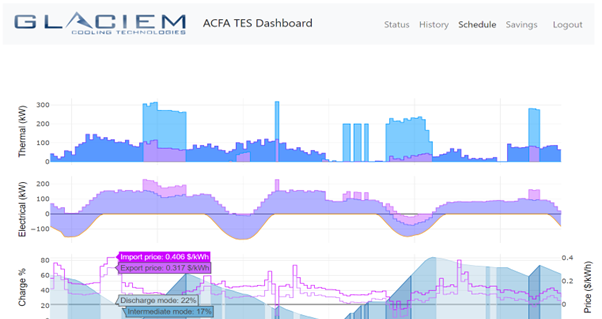
This operational data is taken directly from a live Glaciem installation. ACFA — developed in collaboration with the University of South Australia and supported through ARENA’s Advancing Renewables Program — runs a rolling three-day forecast schedule of thermal load, electrical load, PV generation and wholesale electricity pricing. The schedule is recalculated every 30 minutes, allowing TES to dynamically charge during low-value or curtailed solar periods and discharge when demand and prices peak.

how tes works
Charge → Intermediate → Hold → Discharge
TES operation is not static. ACFA continuously adjusts how the system behaves based on a rolling three-day forecast of thermal load, electrical load, PV generation and wholesale electricity pricing — recalculated every 30 minutes. That’s what enables TES to extract maximum value from renewable energy.
When solar PV is abundant or electricity prices are low (or negative), ACFA directs the chiller to fully charge the TES by freezing the PCM. This captures low-value or curtailed renewable energy that would otherwise be wasted.
Charging (Full Charge Mode)
When forecasts indicate that future prices will be even lower — or that a later period of curtailment is likely — ACFA limits charging to only a portion of the available renewable energy. This prevents TES from filling too early and ensures storage capacity is reserved for the highest-value charging window. Intermediate Mode is what allows TES to behave like a financially optimised energy asset, not just a thermal buffer.
Intermediate Mode (Partial Charging)
Once charged, the PCM remains frozen, storing large amounts of thermal energy in a compact footprint with minimal losses.
Holding
When cooling demand rises or electricity prices peak, TES releases stored cooling to support or replace the chiller. This reduces compressor runtime, flattens load profiles, and protects the site from high-price periods.
Discharging